



What is arbitration?
Arbitration is an alternative to court litigation, where the parties themselves choose one or more arbitrators to resolve the dispute. The procedure is private, flexible and often faster than a traditional trial, as the time required, although it varies, often takes 6–12 months.
Arbitration is particularly well suited to commercial and international contexts, where speed, confidentiality and specialist expertise are crucial. The parties gain greater control over the process and avoid public scrutiny.
How do you apply for arbitration?
Application is made in accordance with the arbitration clause previously agreed upon by the parties. Usually, one contacts an institution, such as the Arbitration Institute of the Stockholm Chamber Institute (SCC), and attaches the agreement along with a brief description of the dispute.
How does the arbitration process work?
- Agreement: The parties include an arbitration clause in their agreement.
- Application: A party initiates the proceedings with an arbitration institution or in accordance with the parties' agreement.
- Appointment: Arbitrators are appointed.
- Exchange of written submissions: The parties submit claims and evidence.
- Hearing: One or more oral hearings shall be held.
- Arbitration award: A decision is rendered, which concludes the case.
In which situations is arbitration better than litigation?
Arbitration is better than litigation:
- when speed is of the essence
- in complex commercial disputes
- when the parties wish for confidentiality
- in international business with different legal systems.

What is the difference between arbitration and court proceedings?
Arbitration is a private and confidential process, unlike public court proceedings to which the general public normally has access. In arbitration, the parties appoint their own arbitrators, often experts in the relevant field, whereas the court assigns a judge by law.
The process in arbitration is more flexible; the parties can, to a large extent, control how it is conducted themselves. Court proceedings, on the other hand, follow strictly regulated procedures. Arbitral awards are binding and cannot, in principle, be appealed, which provides a quick resolution but less opportunity for correction. In a court, there is normally the opportunity for review in higher instances.
In terms of time, arbitration is often significantly faster, with many cases resolved within a year, whereas court proceedings can drag on, especially if the matter is appealed.
Advantages and disadvantages of arbitration
Advantages of arbitration
- Arbitration is quicker and more efficient than court.
- High level of confidentiality surrounding the process as it is not public.
- The parties may appoint experts as arbitrators.
- Great flexibility in structure and schedule.
- The arbitral award is binding and difficult to appeal.
Disadvantages of arbitration
- Arbitration can become costly, as the parties bear all the costs.
- There are limited opportunities for appeal.
- Arbitral awards do not create precedents because they only apply between the parties and do not affect future legal application.
What is important to consider when making an arbitral award?
- The agreement must contain a valid arbitration clause.
- Select competent arbitrators.
- Prepare documentation and evidence thoroughly.
- Choose a location that supports the process requirements for confidentiality and logistics.
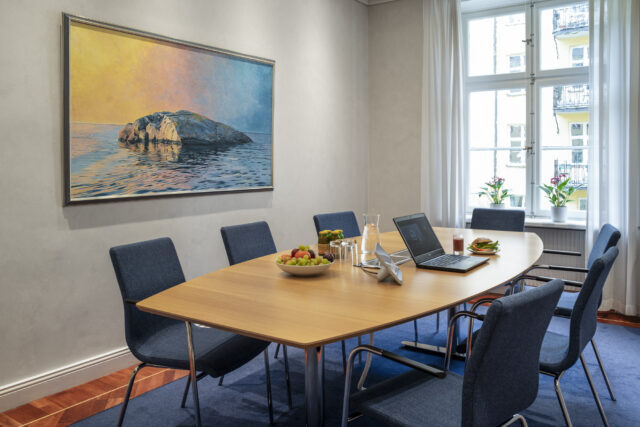
How can IVA Conference Centre help with arbitration?
IVA Conference Centre offers a secure, neutral and discreet environment for arbitration proceedings. The premises are adapted for legal processes requiring confidentiality, technical support and comfort. We are a natural choice for many looking for:
- Quiet, neutral premises in central Stockholm.
- Separate rooms for the parties and the arbitral tribunal.
- Advanced technology for hybrid or remote hearings.
- High confidentiality and experienced conference hosts.
- Opportunity for full-day negotiations in a private environment.
Would you like to know more about our arbitration premises in central Stockholm? Here can you read more about it. Do you need to book a room or do you have more questions? Don't hesitate to contact us – we're happy to help!
Frequently asked questions about secure meetings
We always have a manned reception desk at the entrance and keep an eye on all guests entering and leaving.
IVA has its own IT technician and also employs an engineer who works specifically with cyber security. Our firewalls are extremely high. We can arrange for a separate IP address and network if necessary.
All groups will be given a key to their conference room to lock up during the day. Outerwear and larger bags are left in the wardrobe. If necessary, we can hire security through security companies, for example at annual general meetings. Larger events often have registration of participants on arrival. High-risk participants always have their own personal protection with them.
We operate under the GDPR regarding personal data. Materials and presentations emailed to us are deleted immediately after completion. Recordings from webcasts are deleted after the customer has received their material.